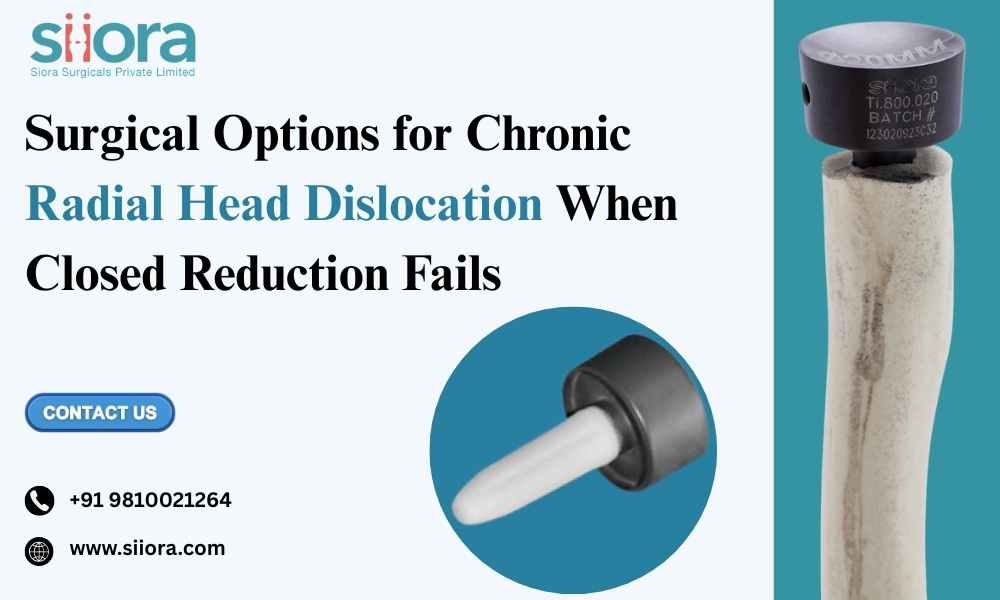
Chronic radial head dislocation is a complex and relatively uncommon condition that presents a significant treatment challenge for orthopedic surgeons. It often results from missed injuries, delayed diagnoses, or failed closed reduction attempts during the acute phase. When conservative management proves ineffective, particularly in long-standing cases, surgical intervention becomes essential to restore elbow function and stability.
Understanding Chronic Radial Head Dislocation
The radial head, located at the top of the radius bone in the forearm, plays a key role in elbow movement and stability. It articulates with the capitellum of the humerus and the radial notch of the ulna, allowing for forearm rotation. Dislocation disrupts these relationships, leading to restricted movement, pain, and functional impairment.
In chronic cases, defined as those persisting beyond 3–4 weeks, the surrounding soft tissues adapt to the dislocated position. The annular ligament, which stabilizes the radial head, often becomes scarred or torn, while adaptive changes such as bony remodeling, joint stiffness, and even ulnar deformity may occur. By this stage, closed reduction is no longer a viable option.
Surgical Indications
Surgery is typically recommended for chronic radial head dislocations that:
- Cause significant pain or discomfort
- Limit forearm rotation or elbow flexion-extension
- Result in cosmetic deformity
- Are associated with neurological symptoms (e.g., posterior interosseous nerve palsy)
- Occur alongside other skeletal abnormalities such as Monteggia fractures or congenital deformities
Common Surgical Options
- Open Reduction and Annular Ligament Reconstruction
This is the most frequently employed approach. During surgery, the radial head is exposed through a lateral incision, and fibrotic tissue is cleared to allow realignment. Because the annular ligament is often non-functional, reconstruction is necessary using a tendon graft, typically from the triceps or palmaris longus tendon. This helps re-establish radial head stability and allows for normal pronation and supination.
Outcomes are generally favorable when surgery is performed before significant degenerative changes occur. However, postoperative rehabilitation plays a key role in maintaining motion and preventing stiffness.
- Radial Head Osteotomy
In cases where the radial head cannot be repositioned due to deformity, or where ulnar malalignment contributes to instability, an osteotomy may be required. This involves surgically cutting and realigning the bone to restore proper joint congruency. It’s particularly useful in chronic Monteggia lesions where the ulna has healed with a bowing deformity, preventing radial head relocation.
- Radial Head Resection
Resection, or removal of the radial head, is considered a salvage procedure, typically reserved for adults or non-functional joints where other options have failed. While it may relieve pain, it comes at the cost of elbow stability and can lead to complications such as proximal radial migration and wrist pain due to altered biomechanics.
In children, this option is avoided due to the risk of growth disturbance and long-term instability.
- Radial Head Arthroplasty (Replacement)
In cases where the radial head is fragmented, malformed, or severely arthritic, prosthetic replacement may be considered. Radial head arthroplasty aims to restore joint mechanics while providing stability. It is more commonly performed in adults and can offer good functional outcomes when combined with ligament reconstruction or osteotomy.
- Corrective Ulnar Osteotomy
Chronic dislocations often involve a malunited ulna from an unrecognized Monteggia fracture. A corrective osteotomy of the ulna can restore the normal alignment, enabling spontaneous or facilitated reduction of the radial head. This procedure is especially relevant in pediatric cases and can sometimes eliminate the need for direct radial head intervention.
Postoperative Rehabilitation and Outcomes
Surgery is only part of the solution. A carefully structured rehabilitation program focusing on gradual mobilization is essential to regain function and prevent recurrence. The timing and intensity of physical therapy are adjusted based on the surgical method used and the patient’s overall condition.
Long-term outcomes vary depending on the chronicity of the dislocation, the presence of associated injuries, and the surgical approach. Early diagnosis and timely intervention remain the best predictors of successful recovery.
Final Thoughts
In conclusion, while closed reduction is effective in acute cases, chronic radial head dislocation requires a more invasive and tailored approach. Surgery offers a viable path to pain relief and functional restoration, but success hinges on accurate diagnosis, appropriate surgical planning, and dedicated rehabilitation.
If you want to become a partner of one of the top orthopedic medical device companies in Namibia, contact Siora Surgicals Pvt. Ltd., a leading manufacturer and supplier of quality trauma implants and instruments.
 siiora surgicals pvt. ltd